Booking a Pre-Wedding Shoot in Japan: 12 Questions to Ask Before You Pay

The short answer
In Japan the terms matter more than the price list.
A pre-wedding shoot here is normally paid before you fly, so what you are really buying at the moment of payment is a set of conditions. Two of them are specific to Japan. Japanese law voids any cancellation charge larger than the seller's actual average loss. Cooling-off, the automatic right to change your mind, does not apply to bookings made online. Below are the twelve questions we would ask any studio, each with our own answer beside it.
Two things about Japan worth knowing before you send money
A cancellation fee has a legal ceiling. Article 9 of Japan's Consumer Contract Act makes void the part of any cancellation charge that exceeds the average loss the business actually suffers. Wedding cases have been argued on exactly this point, with the loss calculated from the value of the booking, the margin on it, and how likely the date is to be resold. A studio is entitled to keep something when you cancel. A clause that keeps everything, whatever the notice, is the kind of clause this article exists to strike down.
Cooling-off does not apply to an online booking. Japan's cooling-off right was written for doorstep and telephone selling, where the customer is caught off guard. A shoot you found and booked on a website is distance selling, and there is no automatic right of withdrawal. What governs instead is the studio's own published refund policy, and under the Specified Commercial Transactions Act that policy has to be displayed. If a site shows no refund terms at all, the statutory default is narrow and mostly aimed at returning goods, which is little help when what you bought is a date.
Ask each studio for an itemised written quote confirming every charge before payment.
1. Do we pay a deposit, or the full amount?
This single answer decides how much of your money is exposed, and studios differ more than you would expect. Ask whether the figure is a deposit with a balance due later, when the balance falls due, and whether tax is already in it.
Our answer. Full payment in Japanese yen by secure card payment through Stripe confirms your date, and the final written quote confirms the amount payable. You receive the written terms and confirm them before anything is charged. Your card statement will show TAMAKI PREWEDDING, not an unfamiliar intermediary.
2. If we cancel, what actually comes back?
The least-asked question and the one that decides the most. Ask for the refund as a percentage of what you have paid, not of some notional package value, and ask whether it changes with notice.
Our answer. We refund 90% of what you paid, whatever the reason and whenever you tell us. The remaining 10% covers payment processing and administration. If you would rather not take the money back, we hold 100% of it as a credit you can use for a shoot on any available date up to the same season next year. There is no sliding scale. We would rather the terms be simple enough to remember from a single reading.
3. Can we move the date, and what does that cost?
Trips change more often than couples expect. Ask how many changes, how late, and at what price.
Our answer. Up to 30 days before the shoot, one change is free, and the new date can be as far out as the same season next year. From 29 to 8 days before, a change fee of ¥30,000 applies. Inside 7 days the date can no longer be moved; if you cannot attend, the refund terms above apply instead.
4. Which currency will my card really be charged in?
Almost nobody writes about this, and it quietly costs people money. When a foreign card is used in Japan, the payment screen may offer to convert the amount into your home currency. That is dynamic currency conversion, and the rate is set by the payment processor rather than by your card network, usually with a margin on top. Choosing to be charged in Japanese yen and letting your own card do the conversion is normally the cheaper path.
Our answer. Our prices are set and charged in Japanese yen. Any figure you see on this site in another currency is an approximation that moves with the exchange rate, and it is not what we bill.
5. What happens if it rains?
Rain policy is where a written sentence is worth more than a reassuring message, because on the day the incentives are not aligned. Ask what specifically triggers a reschedule, who makes that call, and by when.
It helps to know how Japan grades its weather. The Japan Meteorological Agency issues advisories, then warnings, then emergency warnings, in that order of severity. Separately, since 2019 the railways announce planned suspensions ahead of a typhoon, usually a day or two out rather than on the morning itself. That is why "we will decide on the day" is a weaker promise here than it sounds: in a genuinely serious weather event, Japan tells you the evening before.
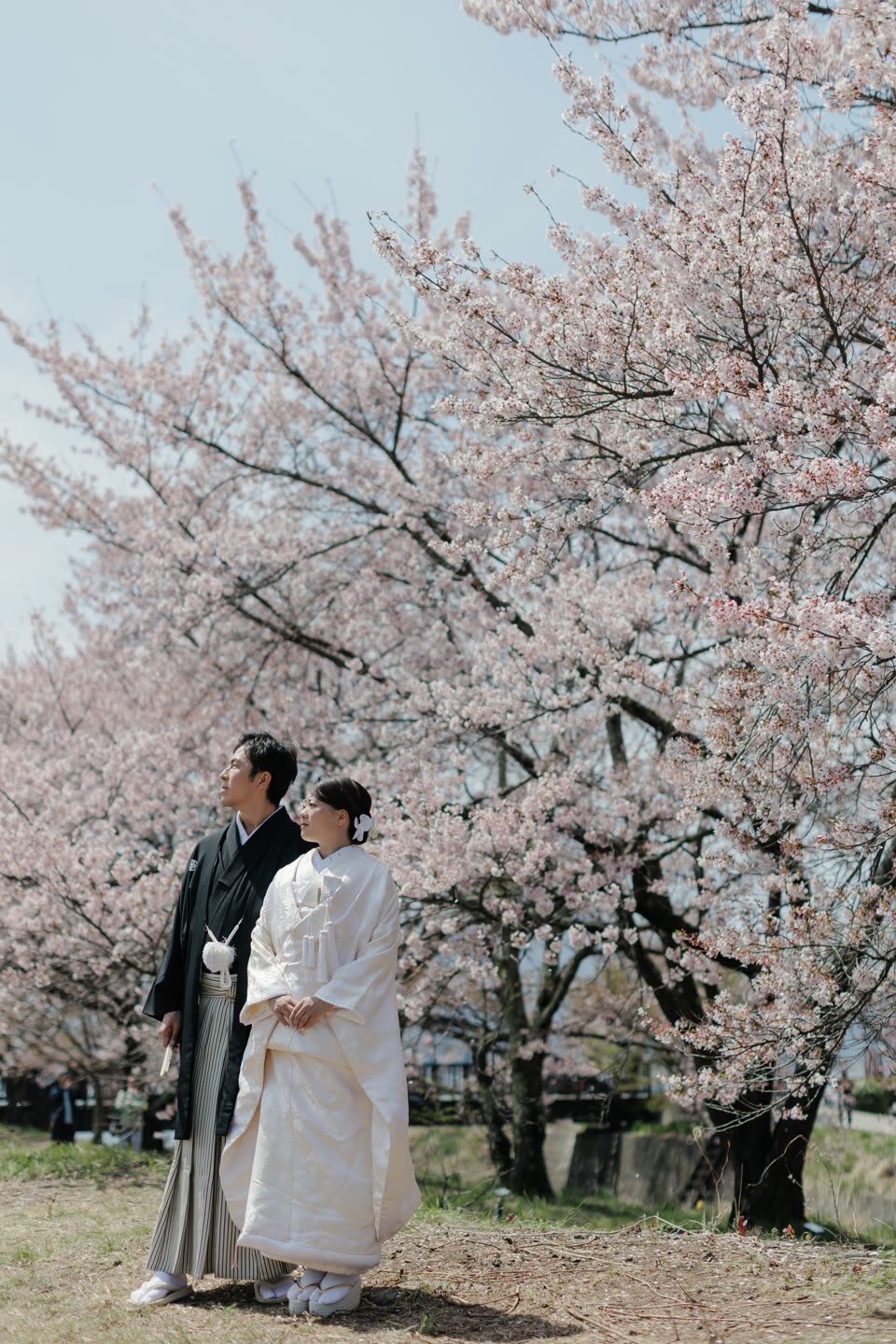
Our answer. We do not cancel for rain. Shrine halls, gates and covered approaches photograph well in wet weather, and rain-washed stone and lit reflections are frames couples often print largest. We reschedule only when an official weather warning is issued or transport stops, and then we set a new date inside your stay at no charge. Two locations carry a plan on top of that. For Mt. Fuji we agree a backup date within your trip when you book. For Okinawa in typhoon season we agree a backup date before confirming at all.
6. Who applies for the permits, and where are you simply not allowed to shoot?

This question tells you, faster than any portfolio, how well a studio knows the ground. Professional photography at a famous location is treated differently from a tourist with a phone, and the rules are specific, local and enforced.
- Tokyo's metropolitan gardens require an application for model and pre-wedding photography. Applications open two months before the date and close a week ahead, and there is an occupancy fee on top of admission. Turning up on the day with a dress is not an option.
- The private lanes of southern Gion in Kyoto have carried notices since October 2019 setting a charge of ¥10,000 for photographing without permission. It is a neighbourhood rule rather than a national law, and it is taken seriously.
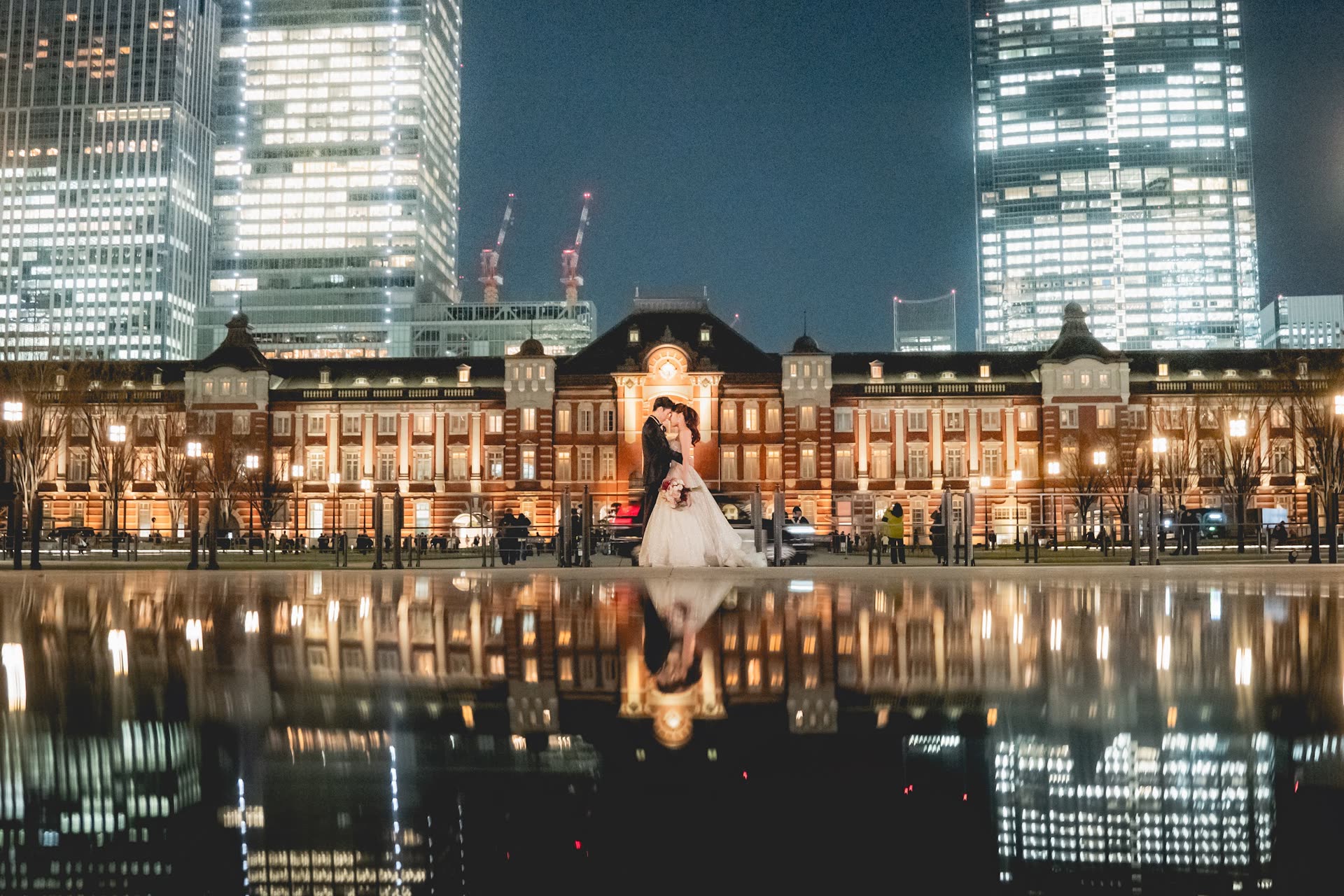
- The plaza in front of Tokyo Station is private railway land. Tripods are not permitted and commercial shooting is restricted.
- Some of Japan's best-known shrines do not admit outside professional photographers at all, at any price, and most do not allow photography inside the main hall.
- Rules change. Bise, the fukugi-lined lanes in northern Okinawa that appear in a great many portfolios, closed to wedding photography in April 2025 after the neighbourhood association acted on years of congestion and complaints. Any studio still offering it is working from an old list.
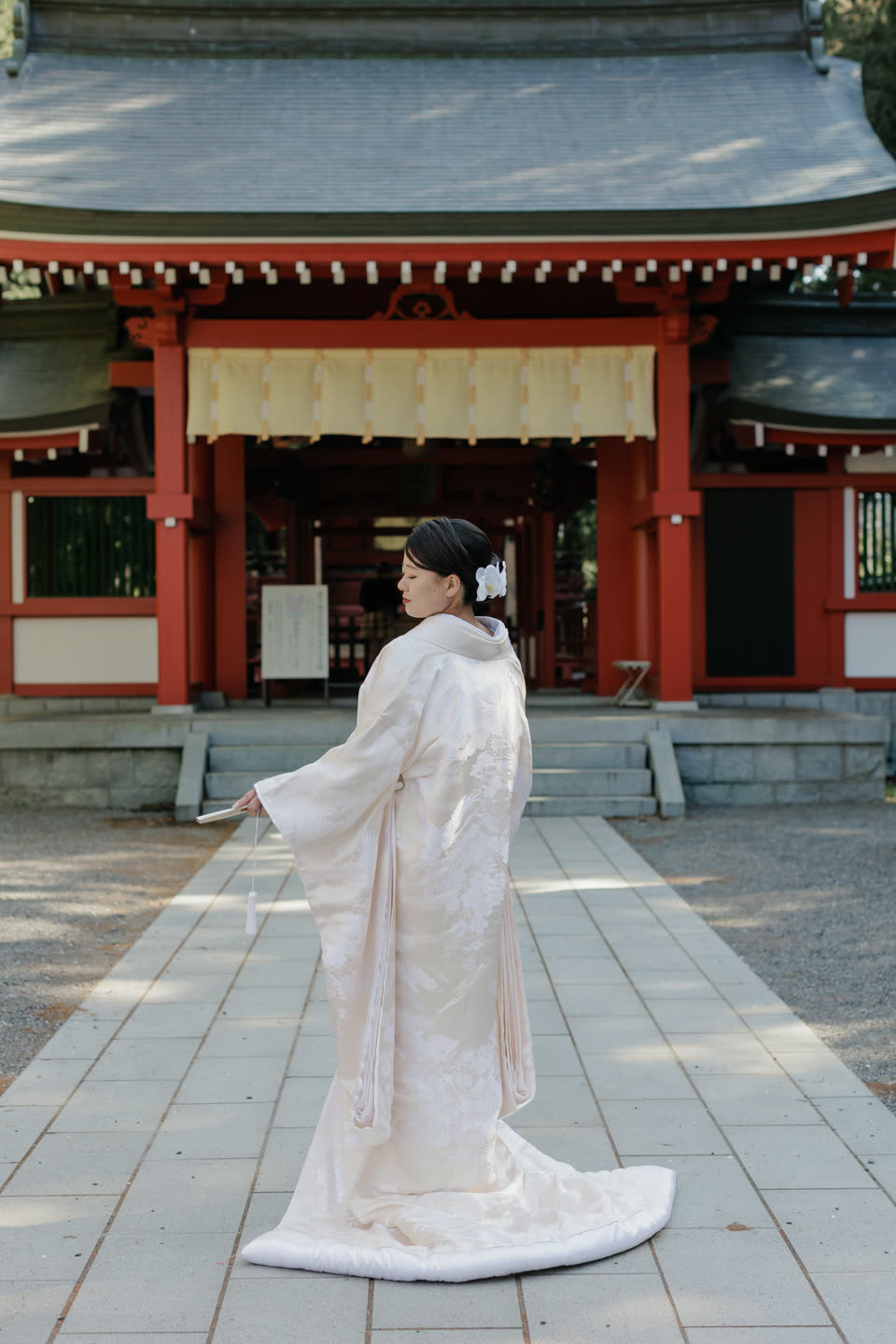
Our answer. Applying and paying is our job, included for the locations listed in your package. We confirm each site's own rules before we promise it to you, which is why we will not name a specific temple in a first reply and then discover a condition later. Kyoto in particular allows kimono only at some temples and gardens, and most shrine grounds do not admit Western gowns, so the dress look is planned into another setting on the same day.
7. Who will be standing next to us, and in what language?
The most common complaint in Chinese-language forums about shooting in Japan is not the photographs. It is that the direction on the day narrows to a few English words, and a couple who had a clear idea in their heads come home with someone else's idea of them.
Our answer. Planning happens in writing, in English, Traditional or Simplified Chinese, Korean or Japanese, so nothing is lost between messages. On the day, if you would like one, a person who speaks English or Chinese is there with you throughout. We reply to enquiries within 24 hours.
8. What does the day actually look like?
Ask for a timeline in hours, not adjectives. "Half day" is a scheduling term, and it does not mean half a day of photography.
Kimono is the reason. Hair and make-up followed by dressing in shiromuku runs to roughly two and a half to three hours in total in the Japanese bridal trade, of which the dressing alone is an hour or more; changing from shiromuku into an irouchikake mid-shoot takes a further fifteen to forty minutes. Add that to a start timed for early light and a half-day booking occupies most of a morning.
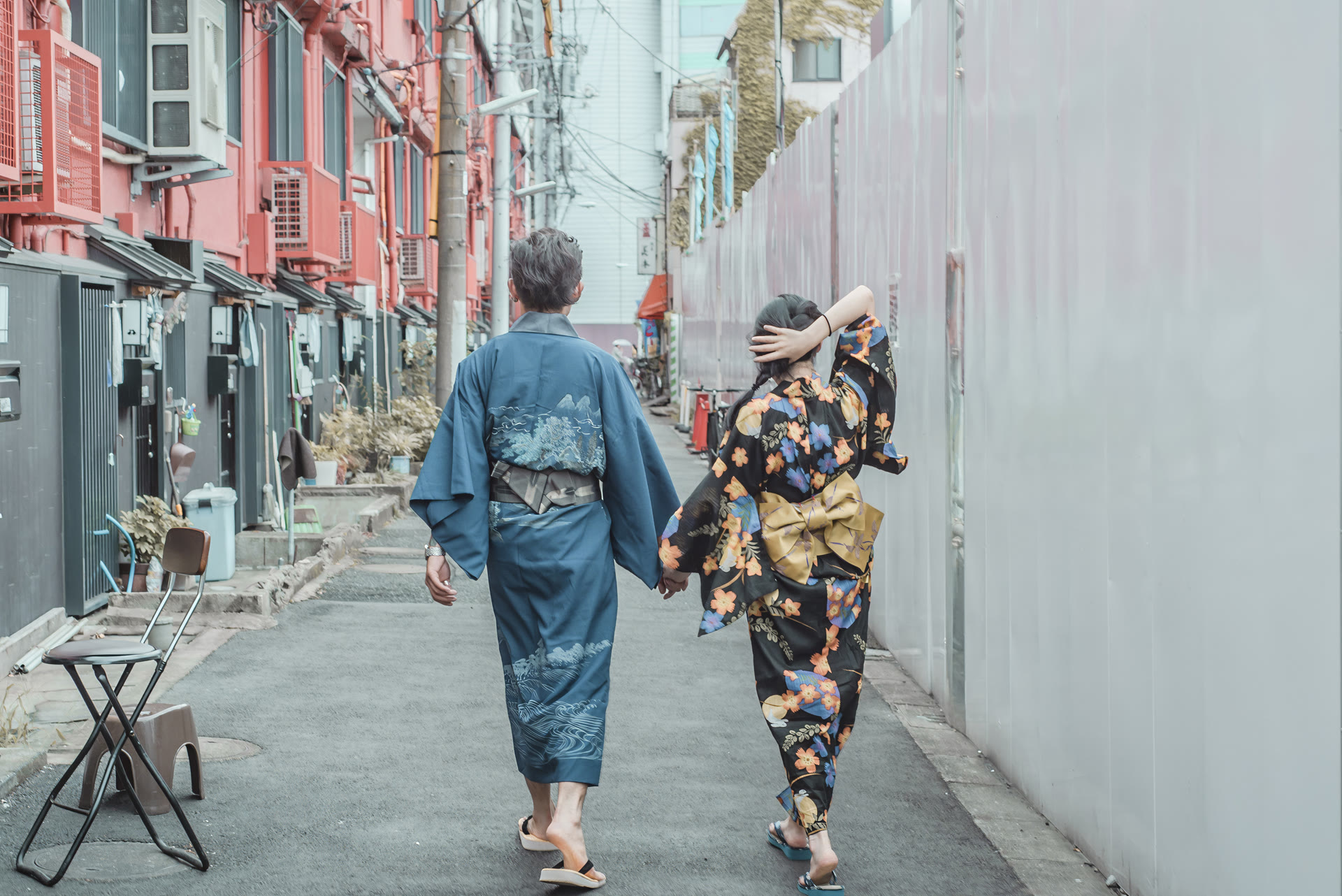
Here is one realistic Tokyo morning in kimono. It is a model case, not a schedule: every day differs with the season, your outfit and the location, and we build the actual order, start time and pace around what the two of you want.
- 05:30 hair and make-up begin at the dressing room.
- 07:00 kimono dressing, done by a professional dresser. This is not something you can do yourselves.
- 08:00 first frames at Asakusa, before the Nakamise shops open and while the approach is still quiet.
- 09:30 the back lanes behind the temple, where the crowds never reach.
- 11:00 finish.
Read that as one model case and nothing more. Every element of it is yours to move. Couples who dislike early mornings shoot in the afternoon into blue hour instead; couples who want a long lunch in the middle take a full day rather than a half; couples who care more about one particular place than about empty streets accept the crowd and we work with it. Tell us what matters most and what you would rather avoid, and we build the order, the start time and the pace around that answer rather than around this list.
The same logic explains something about Mt. Fuji that surprises most couples. At Lake Kawaguchi the sun rises at about 6:55 in mid-January but at about 4:41 in mid-July. To be dressed and standing in position for a July sunrise, if the sunrise itself is what you want, you would begin at around two in the morning. Visibility is the headline reason we steer Fuji into the winter months. The clock is the quieter one. Either way, the start time is yours to set, and a later, gentler morning is always an option.
9. What is included in the outfit, and what must I bring myself?
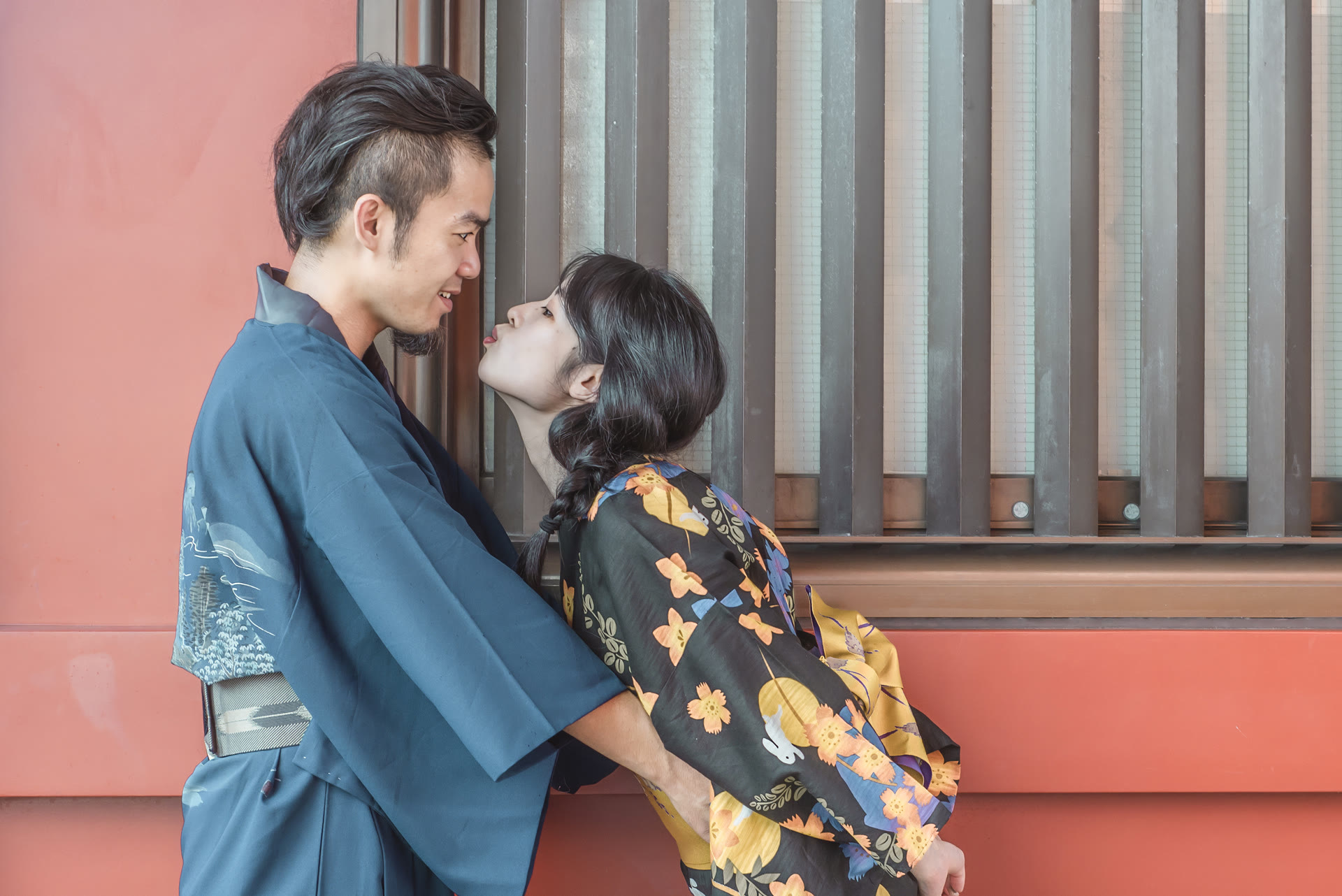
Kimono cannot be put on unaided, so "outfit not included" usually means two further invoices, one for the garment and one for the dresser. It is also worth asking what the studio expects you to arrive with, because in Japan a short list of items is conventionally the bride's own.
Those items are typically the hadajuban and susoyoke worn under the kimono, koshihimo cords, white tabi socks, and towels used for padding the silhouette. Studios differ, and a studio that has never said any of this to an overseas couple has probably never thought about it.
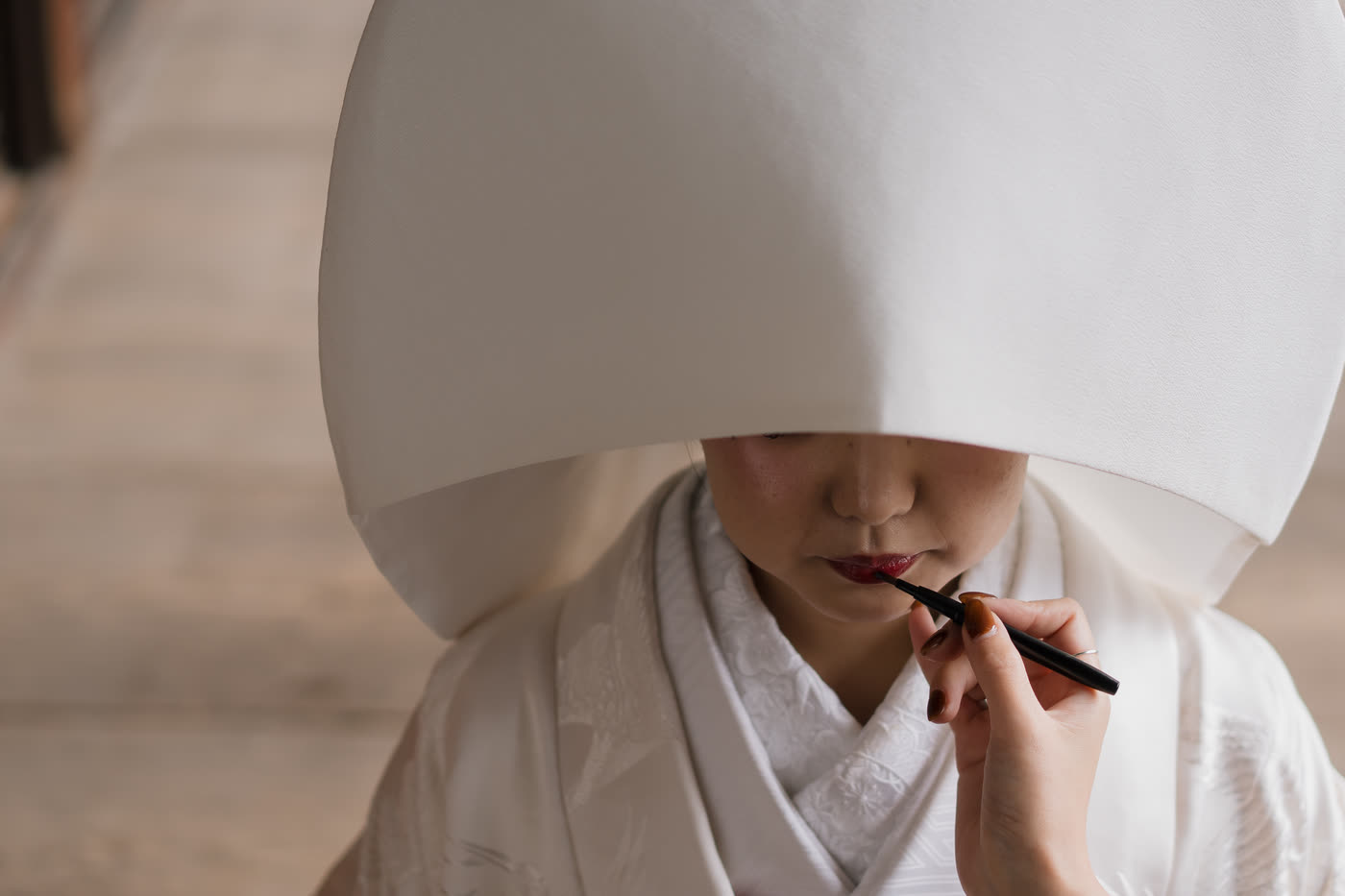
Two pieces of headwear come up constantly and are not interchangeable. The wataboshi, the deep white hood that frames the face, is worn with shiromuku only. The tsunokakushi, the flat band that leaves the traditional hairstyle visible, works with shiromuku, irouchikake and hikifurisode alike. Which one you choose changes the portrait more than the kimono does.
Our answer. Every package includes your outfit, kimono or dress by plan, professional dressing, and hair and make-up. We work with a Japanese partner house, so larger and smaller sizes are both available; tell us your measurements early and we confirm before you pay. If you would rather wear your own dress the price does not change, which is worth noting because a bring-in fee of ¥30,000 to ¥100,000 is ordinary in Japan.
10. What does "retouching" actually mean here?
This is where expectations break most often between Japan and the rest of Asia, and the honest reason is that the words have no fixed meaning. Japanese studios distinguish "basic correction", meaning colour, exposure and straightening, from "retouching", meaning work on skin and shape. But no industry body defines either term, and studios use them interchangeably. Two quotes can promise the same word and deliver very different pictures.
A related mismatch: some Japanese studios hand over unedited files, sometimes called raw or, in Chinese, mao pian, and treat editing as an extra. Couples who assumed the finished look was included have been quite reasonably upset.
Our answer. Basic correction is inside the price, not an option bolted on afterwards. Rather than argue about vocabulary, we would rather see what you mean: if you have images whose finish you like, send them to us in chat while we are planning, and we will tell you plainly whether that is what we do. Removing a passer-by, a wire or a sign from a frame is careful work of ten to twenty minutes an image, so it is agreed in advance rather than assumed.
11. How many photographs, and when?
Ask for the number of finished images, whether editing is included in that number, and the delivery window in weeks. For reference, a half-day location shoot in Japan typically produces somewhere around a hundred and fifty exposures, from which a much smaller set is finished. Delivery of two to three weeks is common, and access to every file is frequently sold separately for tens of thousands of yen.
Our answer. Photo Collection and Signature deliver 50 retouched photographs; Premium Full Day delivers 75. Photographs arrive within 3 to 4 weeks by online gallery. The cinematic film and vertical reel, on Signature and Premium, follow within 4 to 5 weeks.
12. What is not included?
A studio's honest answer to this should be short and specific. Ours is this.
- Your flights and hotels. You book your own travel, which keeps your plans in your hands. We are glad to suggest areas to stay and how to reach each location.
- Transfers. We do not provide pick-up. The team's own transportation within the shoot area is included.
- Options, all priced before you decide: a second outfit ¥60,000, an extra location ¥50,000, an extra hour ¥30,000, a full three to five minute film ¥80,000, a fine-art album ¥60,000, a large print ¥25,000. Up to three guests come at no charge; four or more, ¥20,000.
Tokyo, Kyoto, the Mt. Fuji area and Okinawa carry no location addition. The published package price is the same in all four. Shoots elsewhere in Japan are quoted in writing before payment.
When do you actually need to decide?
Our price is identical eleven months out and three weeks out. There is no seasonal surcharge and no early-booking discount, so the honest answer to "why now" has nothing to do with money. It is that several of these doors close on a timetable nobody in this industry controls.
- A Tokyo garden closes a week before. Applications for pre-wedding photography at the metropolitan gardens open two months ahead and close seven days before the date. Inside that final week the answer is no, whoever you book with and whatever you are willing to pay.
- Sakura needs more than one morning. Tokyo's peak bloom has landed anywhere between 22 March and 4 April across the last eleven years. Planning around a thirteen-day swing means holding two or three possible mornings inside your stay, and you can only hold several while several are still open.
- Mt. Fuji has four good months. November to February are the only months when the mountain appears on more than 65% of recorded mornings. A date outside that window is a different proposition, not a slightly worse one.
- Okinawa has one calm window. December to April records no typhoon approaches at all on the 1991 to 2020 normals. From July to September you are booking a backup date as well as a date.
- Kyoto's weekends go before its weekdays. In November, the photographers we work with fill their weekends first. A weekday in the same month is easier to arrange and quieter on the ground.
Working backwards from that, the rule of thumb is four to six months for cherry blossom and autumn leaves, and six to eight weeks for everything else. Shorter notice is genuinely welcome when the calendar allows it. For spring 2027 specifically, sakura dates start being taken during the closing months of 2026, and the Tokyo garden application for a late-March date cannot even be submitted until late January 2027.
None of this is a sale, and none of it ever will be. What runs out is the calendar. Which of those dates actually applies to you depends on your month and your location, and that is a short piece of arithmetic we are glad to do for anyone who asks. Send us your travel month on WhatsApp or LINE and we will work backwards from it, in writing, including telling you plainly if the honest answer is that there is no rush at all.
Two cases worth reading before you pay anyone
These are not our clients and not our stories. They are on the public record, and they are the two failure modes overseas couples actually meet.
Hong Kong, 2020. A couple paid half of a HK$16,380 package for a shoot in Karuizawa. The pandemic made it impossible. The studio offered unlimited changes of date and location, and a shoot in Hong Kong instead, but refused to return the money. The Consumer Council's advice afterwards was to settle the change and cancellation conditions in writing before paying, and to think through what an acceptable substitute would be while you still have leverage.
Taiwan, on a public forum. A package quoted at NT$36,800 was settled at NT$64,660. Nothing dishonest happened. A second outfit, the unedited files, an album, and a travel fee for the make-up artist were each added at their published price, one at a time, after the decision to book had already been made.
The pattern in both is the same. What went wrong was not the photography. It was that the conditions were vague at the moment when the customer still had a choice.
A message you can copy
If you would rather not work through twelve questions, send a studio this and read what comes back.
"Could you confirm in writing: the final amount payable; what is refunded if we cancel, as a percentage of what we pay; whether the date can be moved and at what cost; what happens if it rains and what triggers a reschedule; who applies and pays for permits at the locations we discussed; who will be with us on the day and in what language; how many finished photographs we receive and in how many weeks; and every item that could still change the total."
A studio that answers all of it has told you how it operates. A studio that answers most of it and leaves one line as "we will confirm later" has told you where its risk is being stored. Our pricing page and booking terms hold every figure in this article in one place, and if you are still choosing between locations, our comparison of the four is the next thing to read.
You are welcome to send that same message to us, word for word, on WhatsApp or LINE. We answer every line in writing, in your language, and the answers are the same whether or not you go on to book.
How early should we book?
Is there a deadline we cannot move?
Do we have to start that early?
Can we ask for specific locations, outfits or a particular look?
Do we pay a deposit or the full amount?
What is refunded if we cancel?
Does cooling-off apply to a pre-wedding booking in Japan?
Should I pay in yen or in my own currency?
Do you cancel for rain?
Who applies for photography permits?
Is someone who speaks our language with us on the day?
Is basic retouching included, or charged separately?
Tell us your month. We will do the arithmetic.
One message on WhatsApp or LINE with your travel month and where you are leaning is enough. We reply within 24 hours, in your language, with the deadlines that apply to you and all twelve answers in writing. Nothing is charged until you have read them and decided.