Tokyo, Kyoto, Mt. Fuji or Okinawa? Choosing Your Japan Pre-Wedding Location
The short answer
Choose the trip each location needs.
We photograph anywhere in Japan; these four are the places couples ask for most.
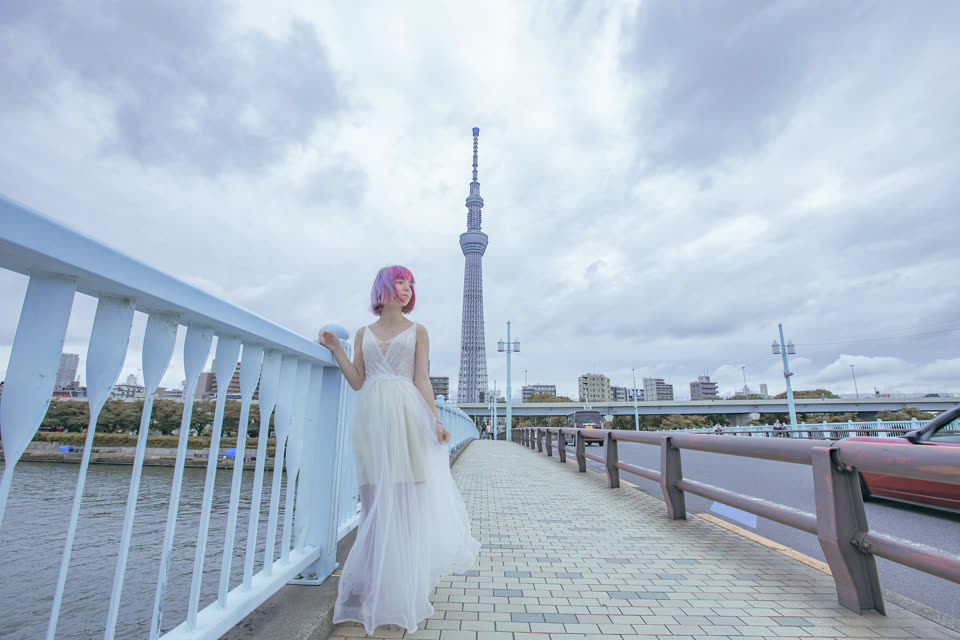
Choose Tokyo if you want kimono and a city look in one Premium Full Day; Kyoto if you are comfortable planning around first light, crowds and permits; Mt. Fuji if your trip can hold two possible mornings; and Okinawa if you can stay at least three days with one spare. TAMAKI recommends the location from your travel window, first-light timing, permit window and backup-day options. Package prices are the same in all four places.
Swipe sideways to compare →
| Location | Signature look | Strongest months | Sunrise, Jan / Jul | Jan low | Weather risk | Days to allow |
|---|---|---|---|---|---|---|
| Tokyo | Kimono in Asakusa, dress at Tokyo Tower, night streets | Late Mar (blossom), late Nov (ginkgo and maple); workable all year | 06:50 / 04:36 | 1.2°C | Lowest. Rain is workable | Arrive the day before, shoot the next day |
| Kyoto | Kimono at temples, bamboo, stone lanes | Late Nov (maple), late Mar (blossom) | 07:05 / 04:54 | 1.5°C | Low, but permits and crowds constrain the hour | Arrive the day before, shoot the next day |
| Mt. Fuji | The mountain above lake and forest | Nov to Feb, by a wide margin | 06:55 / 04:41 | −5.7°C | Highest. The mountain may not appear | Two possible mornings inside the trip |
| Okinawa | White sand, coral walls, banyan forest, island sunset | Oct to Nov, and Dec to Apr for calm | 07:18 / 05:46 | 14.9°C | Seasonal. Typhoons cluster Jul to Sep | Three days or more, with one spare |
Sunrise from the National Astronomical Observatory of Japan, mid-month. Temperatures are Japan Meteorological Agency 1991–2020 normals for Tokyo, Kyoto, Lake Kawaguchi and Naha. Start times in the table are typical for the light and are one model case; the actual day is planned around your wishes.
Mt. Fuji: the number almost nobody publishes
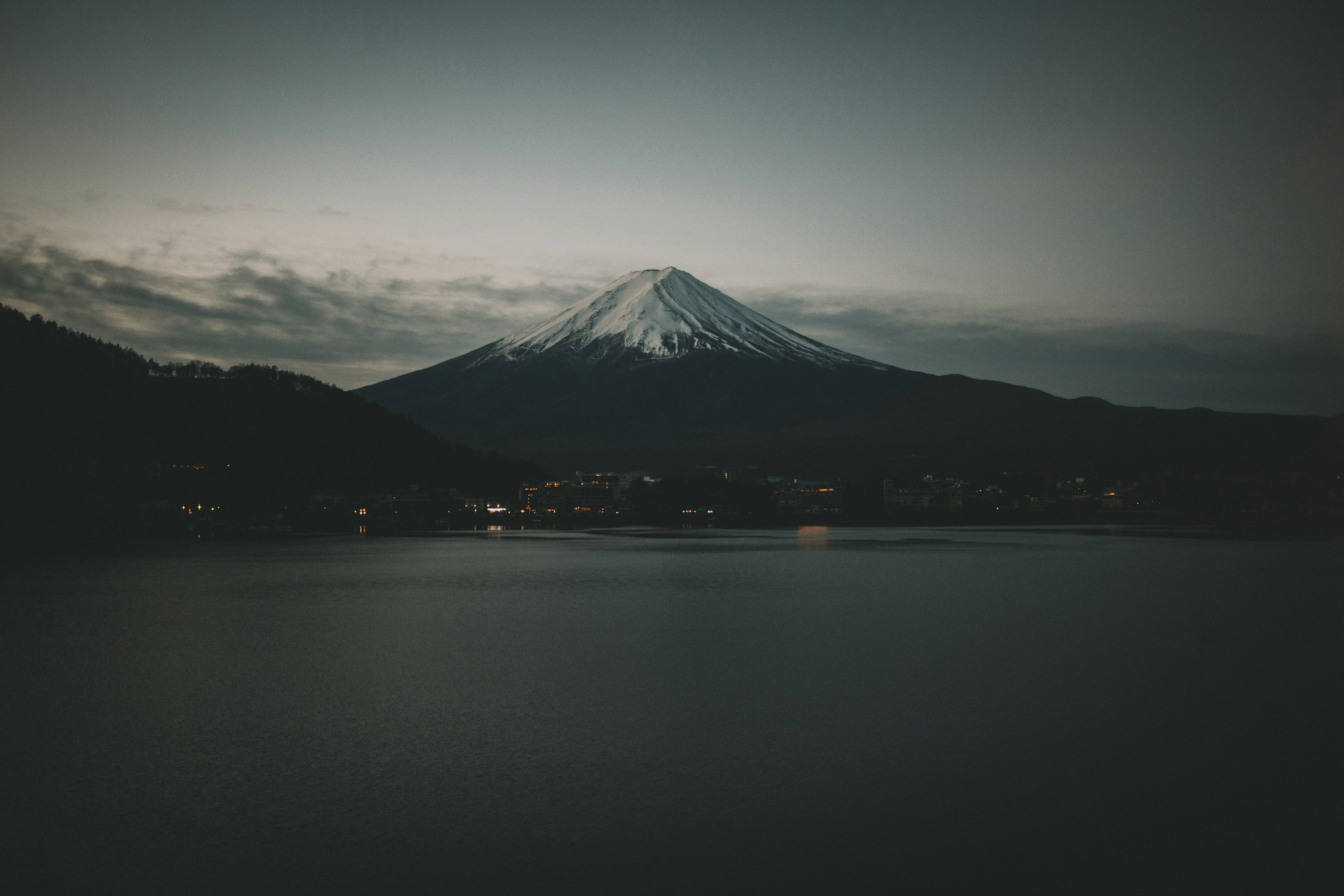
Every studio tells you Mt. Fuji is clearest in winter. Very few will tell you how much clearer, so here is the only long-run public count we have found. Fuji City, on the southern side, has recorded whether the mountain was visible at 8am for twenty-nine years. Averaged across those years:
| Jan | Feb | Mar | Apr | May | Jun | Jul | Aug | Sep | Oct | Nov | Dec |
|---|---|---|---|---|---|---|---|---|---|---|---|
| 65% | 65% | 60% | 55% | 45% | 40% | 23% | 45% | 55% | 67% | 75% | 84% |
A December morning shows the mountain roughly five days in six. A July morning shows it fewer than one day in four. Two honest caveats: this is the southern side and we shoot mainly from the northern lakes, and it is an 8am reading rather than a whole-day figure. Treat it as the shape of the year, not as the odds for your specific date.
The second reason Fuji belongs to winter is the clock. At Lake Kawaguchi the sun rises around 06:55 in mid-January and around 04:41 in mid-July. Since hair, make-up and kimono dressing run to roughly three hours, a July sunrise would mean starting at about two in the morning. A January one means a civilised, if very cold, early start. Sunrise is only the version of the morning that gives the clearest mountain; if you would rather begin later, say so and we build the day around that instead.
And it is cold. Lake Kawaguchi averages a January low of −5.7°C, about seven degrees below Tokyo. In a dress this is not a detail. It is why a Fuji morning is planned in short outdoor bursts with a warm vehicle in between, rather than as a leisurely wander.
On the morning itself, the question is simply whether the mountain is there. Shizuoka Prefecture publishes live cameras with archived stills, which is what we look at alongside the forecast rather than guessing from a general weather app. When you book a Fuji date we agree a backup morning inside your trip, and if the mountain is completely hidden we use it.
Tokyo: the only one where you get both looks in a single day
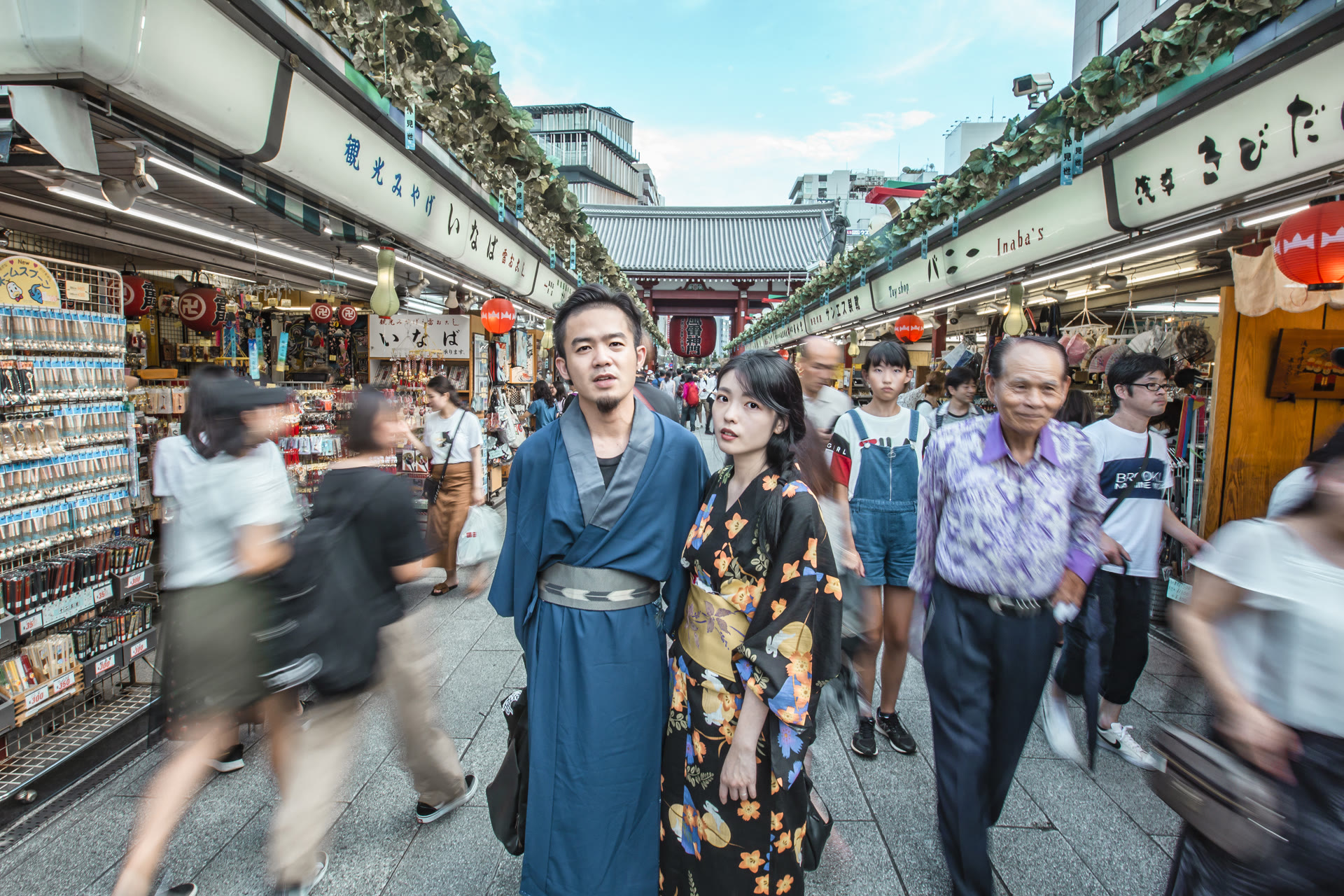
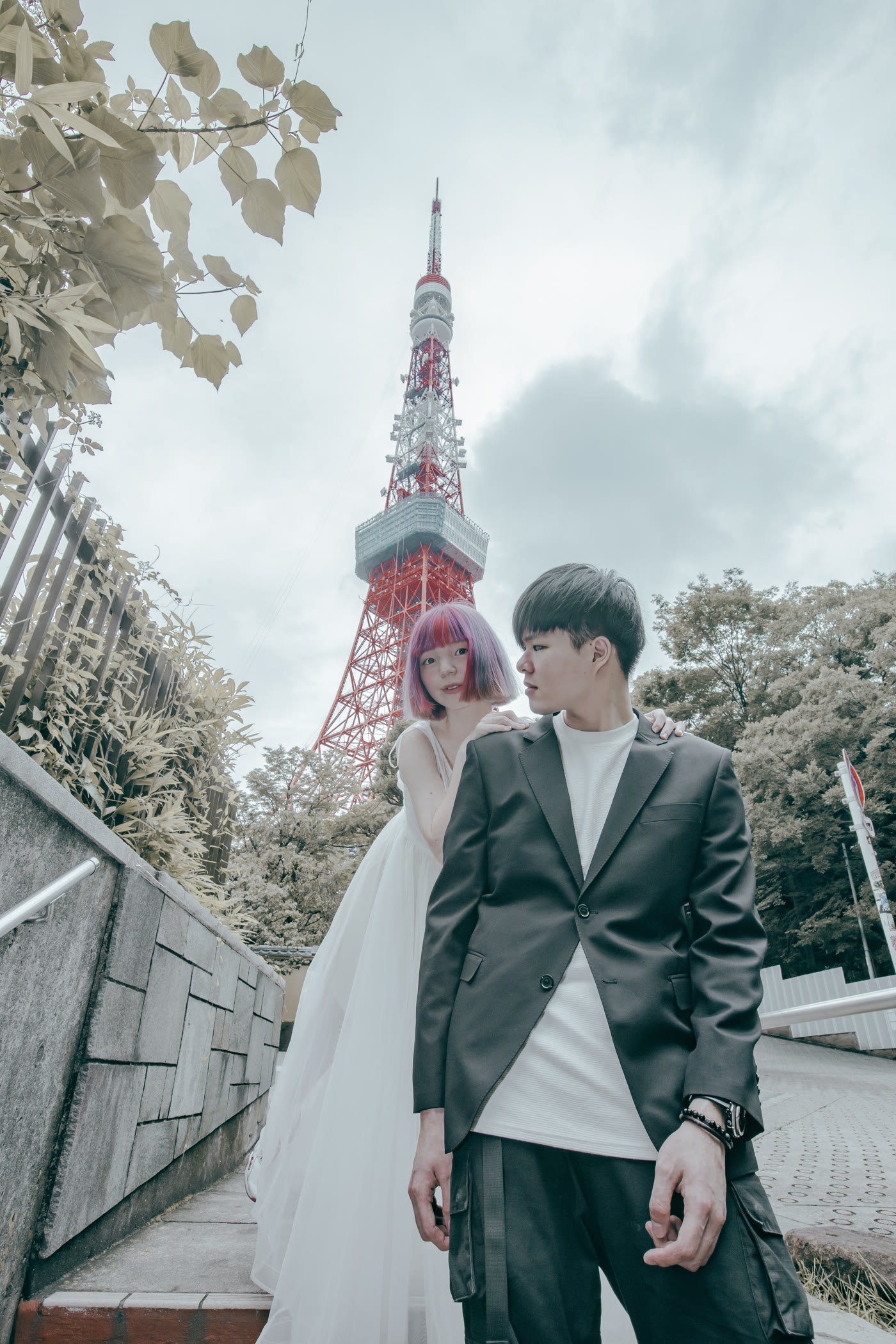
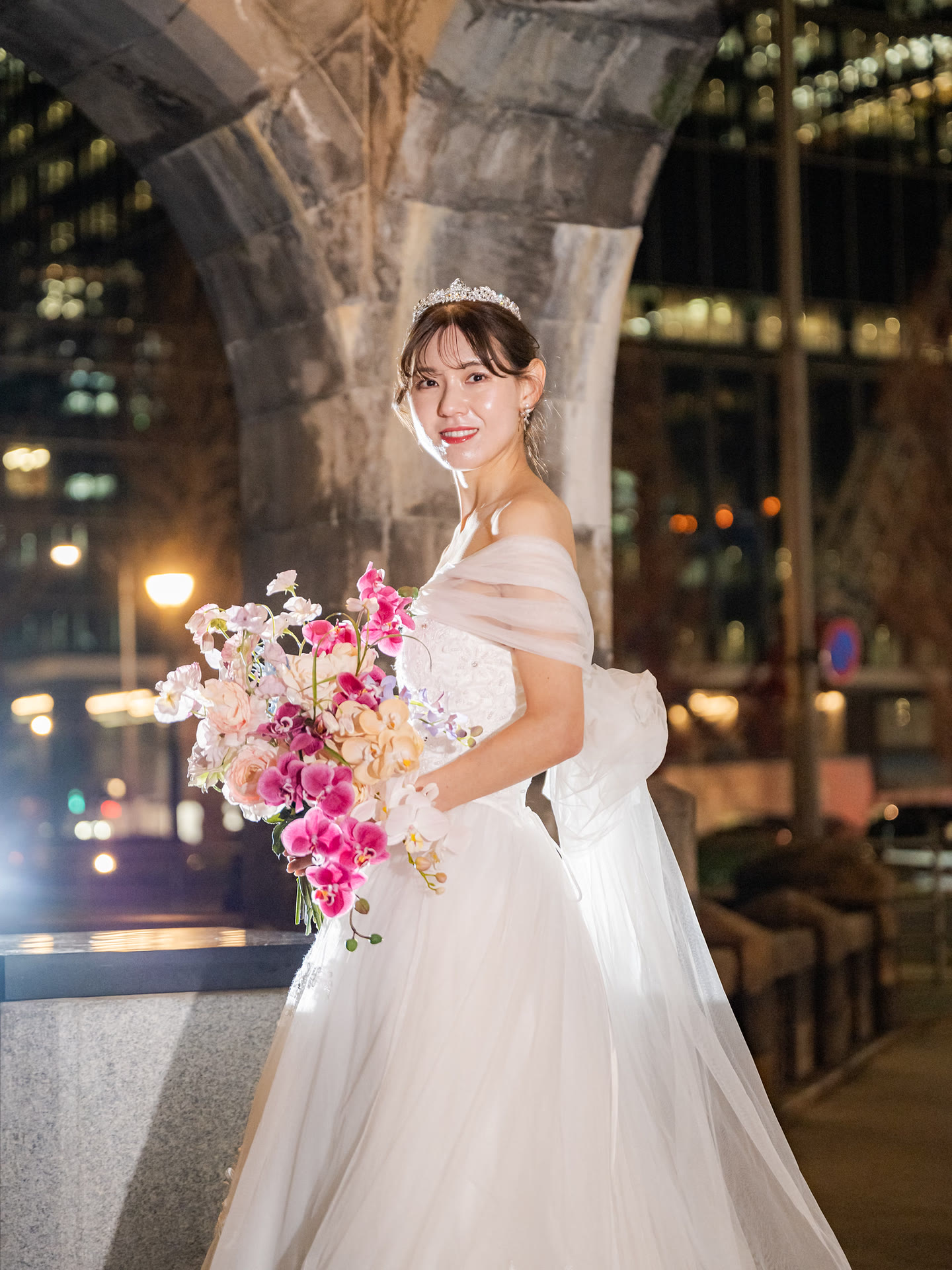
Tokyo is the only location of the four where a kimono morning and a dress evening fit naturally into one day without a long transfer. A half-day package covers one area and its surroundings: Asakusa in kimono before the shops open, or Tokyo Tower and Shiba Park in a dress. Premium Full Day pairs the two, with, for example, Tokyo Station or Shinjuku after dark as the closing scene; the order and the settings are decided with you. Most city hotels are inside thirty minutes by train.
What is worth knowing is where you cannot simply turn up. Tokyo's metropolitan gardens, the classic setting for a kimono portrait, require an application for pre-wedding photography that opens two months before the date and closes a week ahead, with an occupancy fee on top of admission. One of them closed to commercial shooting entirely during a recent autumn-colour season. The plaza in front of Tokyo Station is private railway land where tripods are not allowed. And several of the city's most famous shrines do not admit outside professional photographers at all.
None of this stops a good Tokyo shoot. It just means the itinerary is decided by the permit calendar, not by a list of pretty places, which is why we confirm the sites before we name them to you.
Kyoto: the rules and the clock are the itinerary

Kyoto manages its historic streets more tightly than anywhere else in Japan, and the constraints are specific. In the private lanes of southern Gion, notices posted since October 2019 set a charge of ¥10,000 for photographing without permission. In the bamboo grove at Arashiyama, occupying the path for a commercial shoot is a matter for a road-use permit from the police. A few refuse professional equipment altogether.
Then there is the hour. Arashiyama is close to empty at a quarter to eight and at its worst between about 11:30 and 13:30. Kyoto's own tourism site publishes a live congestion forecast for the main districts, which tells you how seriously the city takes this. A Kyoto shoot that starts at sunrise and finishes before mid-morning is not us being dramatic. It is the way to have the stone lanes to yourselves. It is also only a model case: if a slower start matters more to you than empty lanes, we build the morning that way instead.
One piece of insider timing, from the photographers we work with rather than from any published source. Kyoto's wedding season runs from September into early December, and in November every weekend fills. Weekdays in the same month are comparatively open, and they are also quieter on the ground. Overseas couples on a longer trip have an advantage here that Japanese couples, working around their own weekends, do not.
Okinawa: the calendar decides more than the map
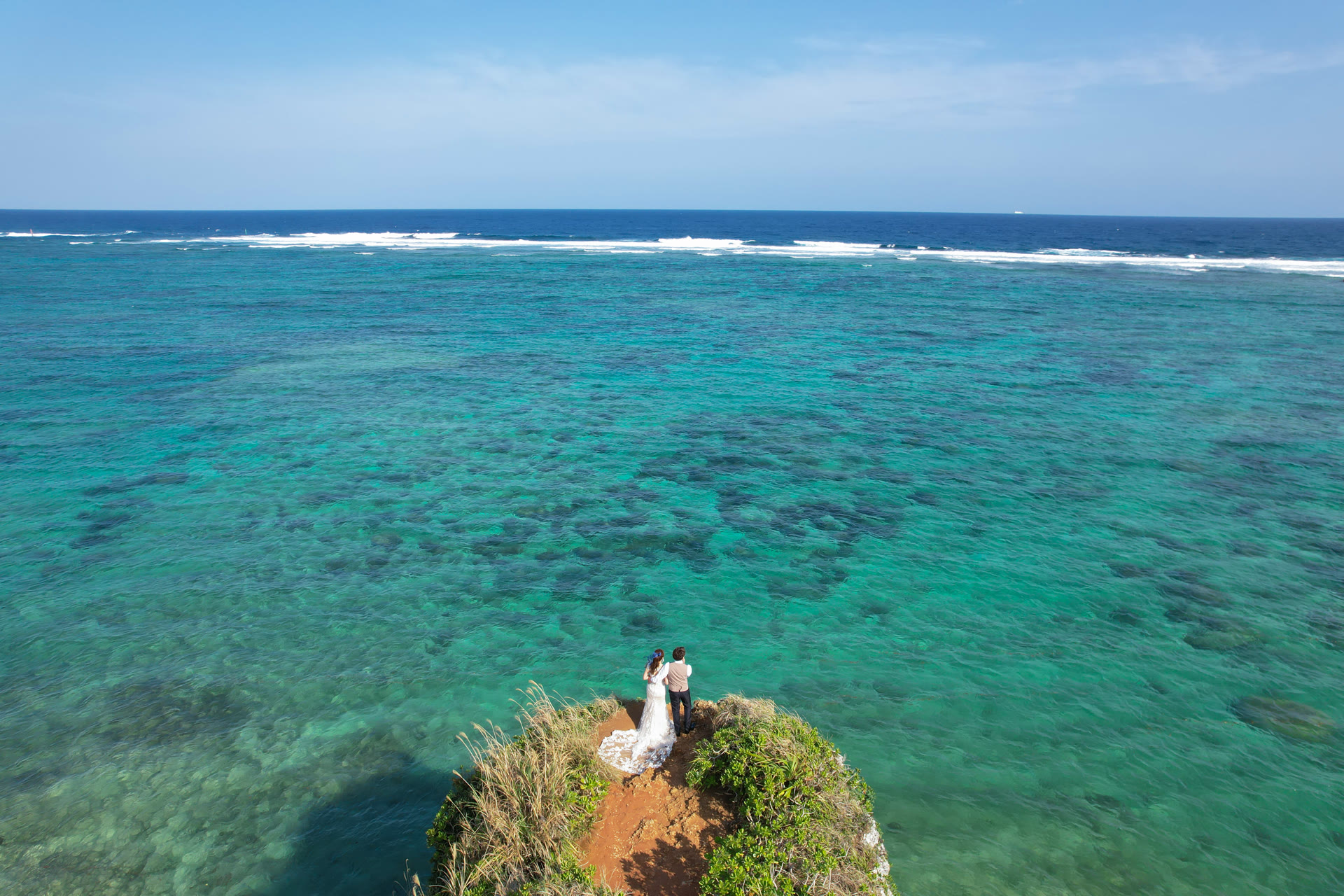
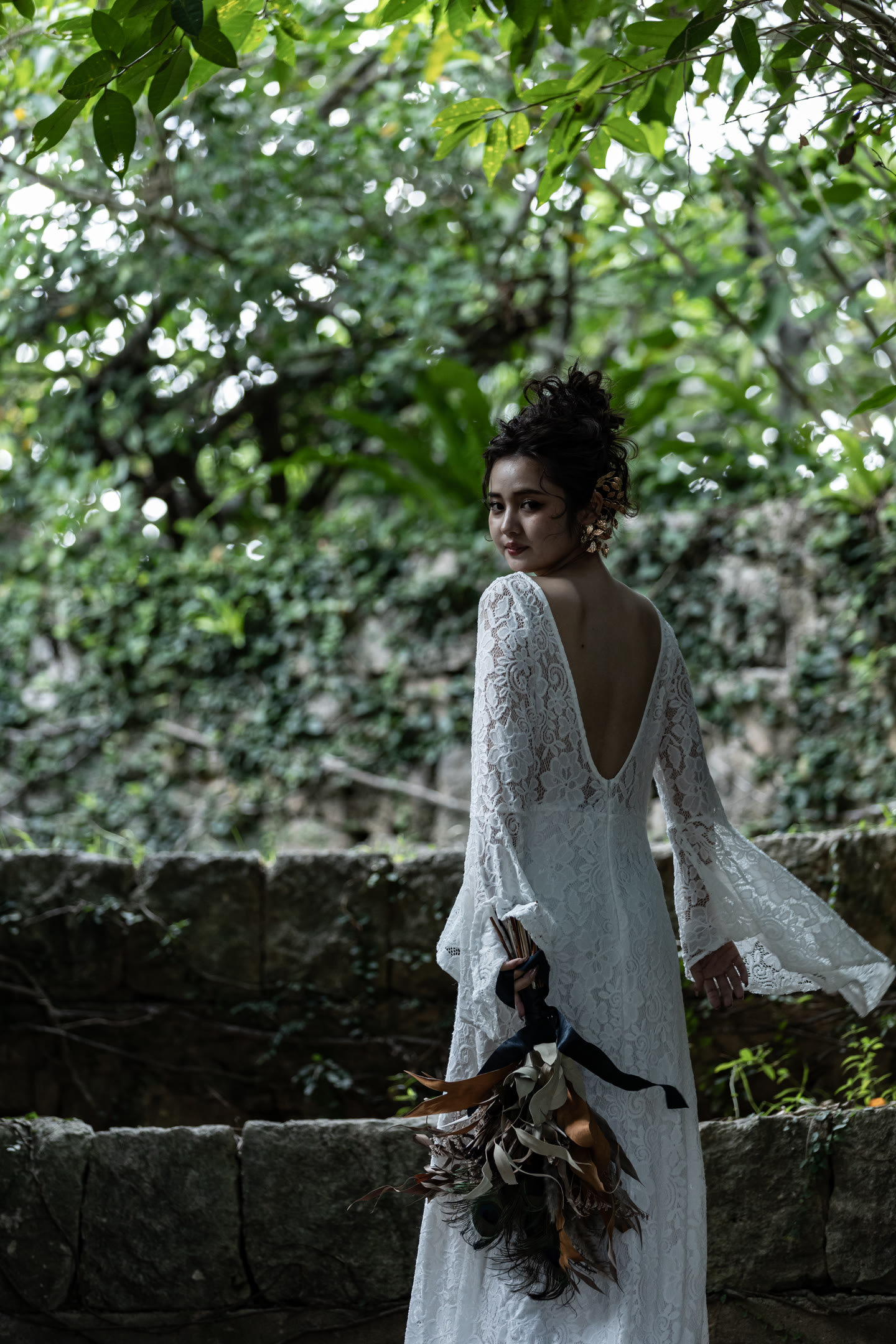
Okinawa's risk is seasonal and it is measurable. Using the Japan Meteorological Agency's 1991 to 2020 normals, the number of typhoons approaching the Okinawa region by month runs: 0.4 in May, 0.6 in June, 1.5 in July, 2.2 in August, 1.9 in September, 1.1 in October, 0.3 in November, and zero from December through April. Roughly 7.7 a year, with three quarters of them landing in a three-month window. The rainy season, separately, normally runs from about 10 May to about 21 June.
That leaves two genuinely comfortable stretches. October and November bring settled seas and long evenings. December to April brings almost no typhoon risk, thin crowds, clear air and a January average low of 14.9°C, warm enough that a dress on a beach is pleasant rather than heroic. High summer is the most vivid water and the least reliable calendar, with a July average high of 31.9°C.
Okinawa also has the latest sunrise of the four locations, about 07:18 in mid-January against Tokyo's 06:50. Furthest south does not mean earliest light, and in practice it means the most humane morning start of any of our locations in winter.
One current note, because portfolios go out of date. Bise, the fukugi-lined lanes in the north of the island that appear in a great many Okinawa wedding galleries, closed to wedding photography in April 2025 after the local neighbourhood association acted on congestion, parking and privacy complaints. A studio still selling it is working from an old list. The island has no shortage of alternatives, and the real planning question is different: because the scenes are spread out, a half-day stays within one area, while pairing the sea with the forest is a full-day plan.
Cherry blossom: what eleven years of data tell you about 2027

If your trip is built around sakura, this is the most useful table in this article. These are the Japan Meteorological Agency's recorded full-bloom dates for Tokyo and Kyoto.
| Year | Tokyo | Kyoto |
|---|---|---|
| 2016 | 31 Mar | 2 Apr |
| 2017 | 2 Apr | 7 Apr |
| 2018 | 24 Mar | 28 Mar |
| 2019 | 27 Mar | 6 Apr |
| 2020 | 22 Mar | 30 Mar |
| 2021 | 22 Mar | 26 Mar |
| 2022 | 27 Mar | 30 Mar |
| 2023 | 22 Mar | 24 Mar |
| 2024 | 4 Apr | 5 Apr |
| 2025 | 30 Mar | 5 Apr |
| 2026 | 28 Mar | 30 Mar |
Two things fall out of it. Tokyo's peak has moved across a thirteen-day range, from 22 March to 4 April, which is why a date chosen a year ahead is a bet and why we hold more than one possible morning inside your stay. And Kyoto has peaked later than Tokyo in all eleven years, by four days on average. If your travel dates are fixed and early in the window, Tokyo is the safer blossom. If they fall in the first week of April, Kyoto is.
Peak bloom lasts roughly a week. The two or three days when the petals come down photograph better than the peak itself, and they are the days almost nobody plans for.
When you actually need to decide
Everything above is a calendar, so it is worth turning it round and reading it as one. Our price does not change with the season and we run no early-booking discount, which means the reason to settle a date early is never financial. It is that these particular doors close on a timetable set by gardens, weather stations and other people's weekends.
Swipe sideways to compare →
| Location | What closes | When |
|---|---|---|
| Tokyo gardens | The permit application window | Opens 2 months before the date, closes 7 days before. No exceptions inside that week |
| Kyoto, November | Weekends, before weekdays | The autumn season runs September into early December; weekend dates go first |
| Sakura | The ability to hold several mornings | Peak has landed between 22 Mar and 4 Apr; dates begin going the previous autumn |
| Mt. Fuji | The clear season itself | Only October to February reach 65% of mornings or more. Five months in twelve, best in December at 84% |
| Okinawa | The typhoon-free window | Dec to Apr records no approaches. Jul to Sep needs a backup date agreed at booking |
Worked backwards, a late-March 2027 shoot in a Tokyo garden means the application cannot be filed before late January 2027, and the date itself is chosen during the closing months of 2026 because that is when sakura mornings start being taken. A November shoot in Kyoto means asking about weekdays before weekends. A Fuji morning means naming two mornings, not one.
Our answer to "should we book early?" is the same all year, and it is not a sales line: booking early buys you the date. It does not buy you a lower price, because there isn't one.
If you would like that arithmetic done for your own trip rather than in the abstract, send us the month and the outfit you care about most on WhatsApp or LINE. We will tell you which of the doors above is actually in your way, how many mornings to hold, and, if that is the honest answer, that you have more time than you thought.
What actually changes when your team has shot there before
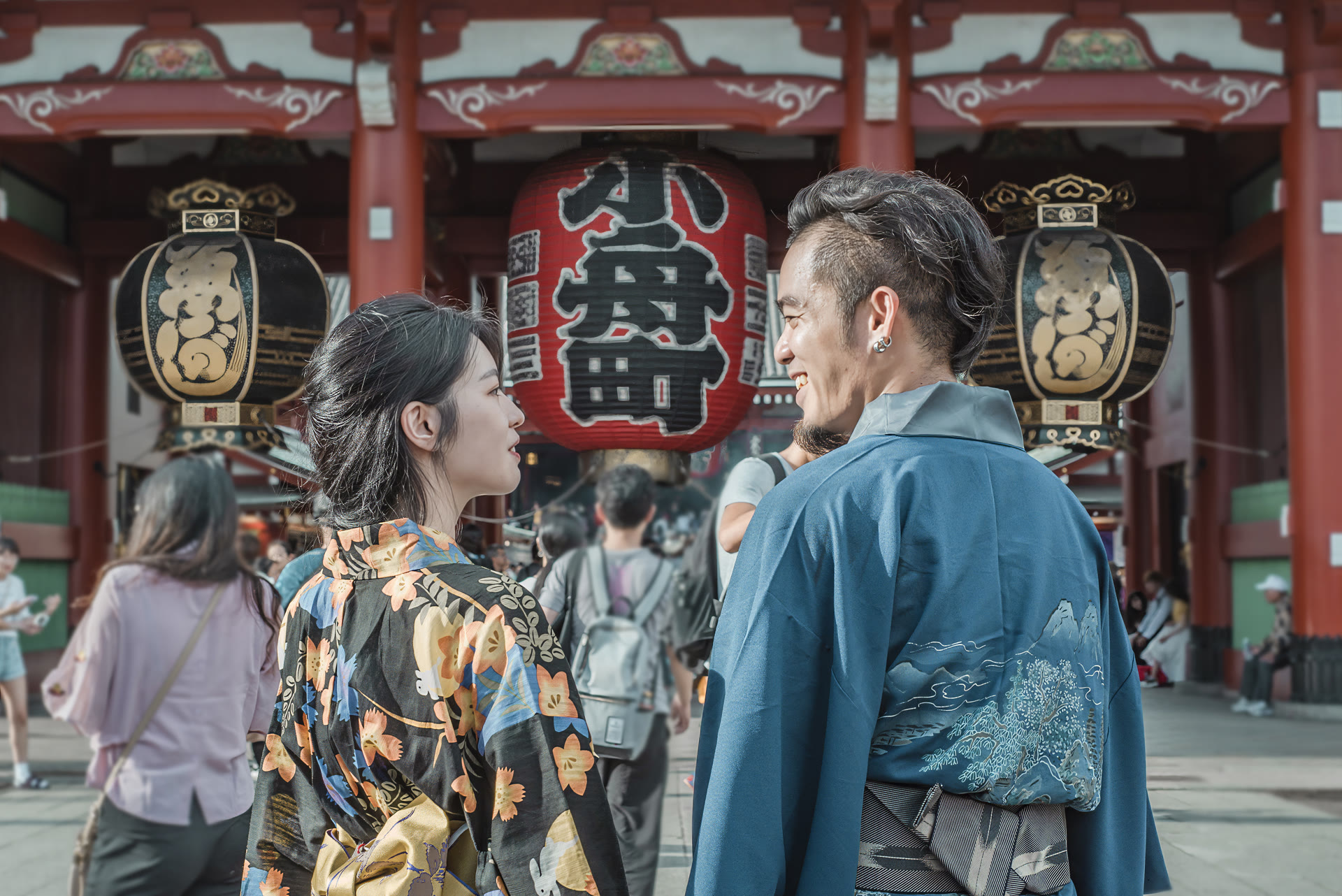
Here is the part of a Japanese shoot that no comparison table captures. At the famous places, position is competed for. On a November morning in Kyoto or a cherry-blossom morning in Tokyo, several photographers want the same three metres, and they arrive early to hold them. Nothing about this appears on a location page, and it is the difference between an hour spent making photographs and an hour spent negotiating.
What experience buys is not access. It is knowing which corner of a site works at which hour, which gate opens before the crowd arrives, which places need an application and how far ahead, and which alternative two streets away is better anyway once the light has moved. We send people who have photographed that specific place before, and we plan the order of the morning around that knowledge, so that the two of you spend the time being photographed rather than waiting.
Deciding in three questions
- Which outfit matters most? Kimono first: Kyoto or Tokyo, and the shrine portrait in shiromuku. Dress first: Tokyo Tower, the lakes below Fuji, or an Okinawa beach.
- Which month are you travelling? November to February favours Fuji and a calm Okinawa. Late March and late November favour Tokyo and Kyoto, booked four to six months ahead. July and August favour none of them outright, and Tokyo handles that pair of months best.
- How many days can you give it? One clear day: Tokyo or Kyoto. Two possible mornings: Fuji. Three days with one spare: Okinawa.
Premium Full Day pairs two settings in one day within one area, with two outfits, 75 photographs and a three-minute film. Tokyo and Mt. Fuji can be combined in one long day if the schedule is built around the early Fuji start. Two different regions, Kyoto and Okinawa for instance, mean two shoot days.
Whichever you choose, the price does not move: ¥260,000 for photography, ¥380,000 with film, ¥550,000 for a full day, in all four locations. Other areas of Japan are quoted in writing before you pay. Our cost guide explains what those figures include, and our booking questions cover the terms behind them.
+ 10% Japanese consumption taxTax-inclusive totals:Photo ¥286,000Photo + film ¥418,000Full day ¥605,000
Is it worth booking early?
What is the latest we can book a Tokyo garden?
Which month is best for Mt. Fuji?
Is Okinawa or Mt. Fuji more expensive than Tokyo?
Tokyo or Kyoto for cherry blossom?
When should we avoid Okinawa?
Can we shoot Tokyo and Mt. Fuji on the same day?
Which location is best for kimono?
Which location is safest for weather?
How early does a Kyoto shoot start?
Beyond the shoot
Choosing a location is choosing a trip
Tell us your dates and the cities you are visiting, and we will suggest the location that fits your trip best. Over chat, we recommend hotels and restaurants by area and by the kind of food you love, and help you plan routes and timing around your shoot. On the day, an interpreter who speaks English, Mandarin or Cantonese can stay by your side, anywhere in Japan.
Send us your month and we will read the calendar for you.
Two lines on WhatsApp or LINE are enough: the month you are travelling and the outfit you care about most. We reply within 24 hours with the location we would honestly suggest, the mornings worth holding, and the start time that implies.